

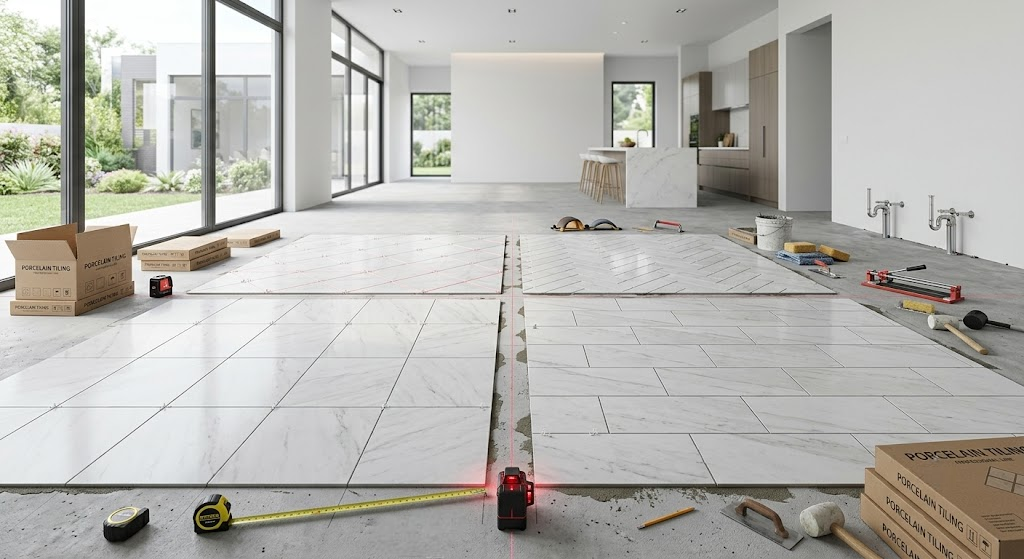
Layout pattern can add real, predictable costs to a tile project beyond the price of the tile itself: a straight lay typically needs about 10 percent extra material for waste, while herringbone or diagonal patterns can push that to 15 to 20 percent, and both also cost more to install because of the extra cuts and alignment time involved. On a 150 square foot floor, that waste difference alone can mean ordering 15 to 30 more square feet of tile than a straight lay would require, plus a higher labor rate per square foot.
Most homeowners compare tile material, finish, and color, then calculate a budget from the price per square foot, without factoring in that the layout pattern changes both numbers. This guide breaks down exactly how much each common pattern adds to material and labor costs, and how to order the right amount of tile before installation begins.
Why Straight Lay Tile Costs Less
A straight lay, also called a grid or stack pattern, is the simplest installation available. Tiles align corner to corner in a consistent grid, which means cuts are mostly straight and edge pieces are predictable. The standard waste factor for a straight lay is around 10 percent, meaning a 100 square foot room needs about 110 square feet of tile ordered to account for cuts, breakage, and irregularities.
Labor costs for a straight lay are also the lowest of any pattern, since installers spend less time calculating angles and making angled cuts. For homeowners on a strict budget, a straight lay gives the most control over what the final bill looks like.
Subway Formats: Running Bond Offsets and Lippage Risks
A running bond, where each row of tile is offset by half a tile from the row above it, is the classic subway tile pattern. It adds more visual movement than a straight grid without adding much to the material or labor cost. The waste factor is similar to a straight lay, generally staying in the 10 percent range for straightforward rooms.
The main place a running bond gets more expensive is with large format rectangular tiles. When long tiles are offset at a 1/3 rather than 1/2 point, the pattern can create visible lippage, where one tile edge sits slightly higher than the next, which requires more careful subfloor preparation and more precise installation.
Why Herringbone Requires More Tile
Herringbone is where the budget math changes most visibly. The pattern requires every tile to be cut at an angle, and because those cuts produce triangular offcuts rather than usable pieces, the waste factor climbs to between 10 and 20 percent, with the higher end applying to rooms with multiple corners, niches, or irregular walls.
On a 150 square foot floor, that difference matters. At 10 percent waste, a homeowner orders 165 square feet. At 20 percent, the same project needs 180 square feet. For tile priced at 8 dollars per square foot, the waste difference alone adds up to 120 dollars in material cost before installation begins.
Why Herringbone Costs More to Install
The material waste is only part of what herringbone adds to a project. Because the pattern requires more individual cuts, more precise angle alignment, and more time spent laying out the pattern before any tile is set, professional installation typically costs more per square foot than a straight lay or running bond.
The exact premium varies by region and installer, but herringbone is consistently cited as a more labor-intensive pattern than straight-lay formats. For homeowners comparing layout options for the same tile, this is the number that most often gets overlooked when an initial quote comes in for just the material.
For anyone navigating both design decisions and project costs at the same time, utilizing a reliable home improvement budgeting guide can help frame pattern selection as a concrete line item rather than a purely aesthetic choice.
Why a Diagonal Layout Can Make a Room Feel Bigger
A diagonal or diamond pattern, where tiles are rotated 45 degrees to the walls, carries a waste factor similar to herringbone, often 10 to 15 percent depending on room shape, since the angled edges at every wall require cuts. Labor is also higher than a straight lay for similar reasons.
The trade-off a diagonal offers is spatial perception. When tile lines run corner to corner rather than parallel to walls, the eye follows those extended lines and the room can feel larger than its actual square footage. This makes the diagonal a particularly common choice in smaller bathrooms and galley kitchens where the visual effect is worth the small cost premium. Before deciding which layout fits your project, it helps to compare how each pattern affects both material waste and installation costs.
Tile Layout Patterns Compared
| Tile Layout | Typical Waste Factor | Installation Labor | Best For |
| Straight Lay | Around 10% | Lowest | Budget-conscious projects and simple layouts |
| Running Bond | Around 10% | Low | Classic subway tile designs with minimal added cost |
| Diagonal | Around 10–15% | Moderate | Smaller rooms where a larger visual effect is desired |
| Herringbone | Around 15–20% | Highest | Decorative feature floors and premium design projects |
Why Tile Size Changes Material Waste
One detail that affects waste calculations across all patterns is tile size relative to room dimensions. A large format tile in a herringbone pattern wastes more material per cut than a small subway tile in the same pattern, since each cut removes a larger piece of usable material. For a 12×24 tile in herringbone, the waste factor can exceed 20 percent in rooms with many obstacles, outlets, or corners.
Because tile dimensions have such a significant impact on waste, many homeowners compare layouts before selecting a specific product. Browsing a dedicated herringbone tile collection that is sized and rated for this pattern takes the guesswork out of which tile format actually works for the layout you want.
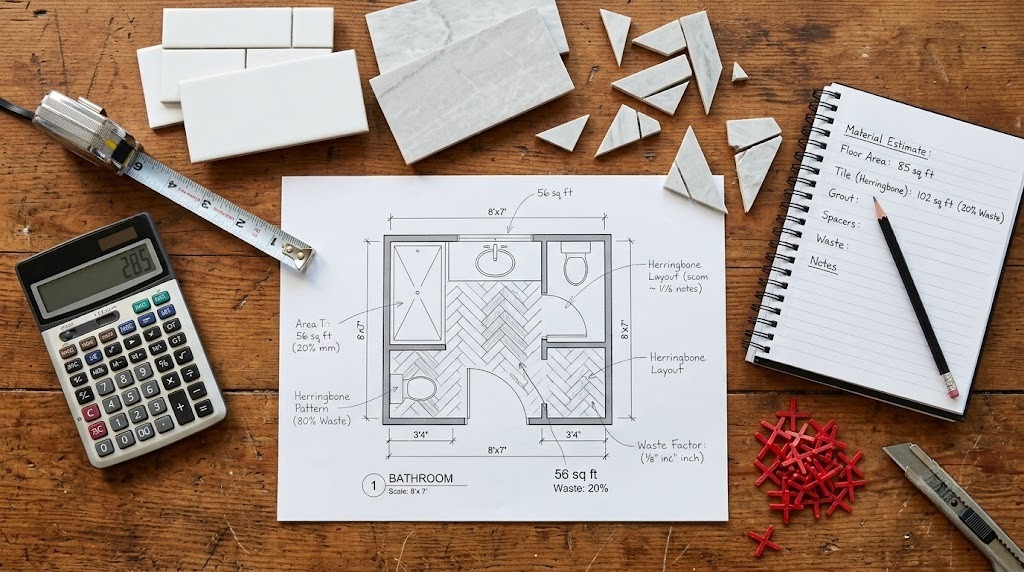
Alt text: Calculating tile quantities and planning material waste before installing a herringbone tile floor.
How Much Extra Tile Should You Order?
The practical rule is to calculate the square footage of the space, apply the appropriate waste percentage for the pattern, and round up to the next full box rather than ordering to the exact number. Tile is sold in boxes, and a single box short means waiting for a reorder that may come from a different production batch with slightly different color variation.
For straight lay or running bond, adding 10 percent to the square footage is usually sufficient. For herringbone or diagonal in a standard room, 15 percent is a safer buffer. For herringbone in a room with multiple alcoves, around a bathtub, or in a corridor with many doorways, 20 percent is the more conservative and reliable figure. Choosing an online tile store that clearly lists coverage per box, recommended waste factors, and product specifications makes it much easier to calculate the correct order before purchasing.
Conclusion
Tile layout patterns are not just a design decision. Straight lay and running bond stay close to a 10 percent waste factor and carry standard labor rates, while herringbone and diagonal push waste to between 15 and 20 percent depending on room complexity, and both add to professional installation costs because of the additional cuts and alignment time they require. Choosing a pattern before calculating the tile order, rather than after, keeps the budget accurate from the start rather than forcing adjustments once installation is underway.
For readers set on a herringbone or pattern-driven look, Mineral Tiles, a U.S.-based online tile store, carries herringbone tile in ceramic, porcelain, glass, and natural stone, worth a look if you want to weigh material options alongside the cost factors above before ordering.
Tile Layout FAQs
Can I reduce herringbone waste by choosing a different tile size?
Yes, smaller rectangular tiles generally produce less waste in a herringbone layout than large format tiles, since each angled cut removes less material per piece. A 3×6 or 3×12 subway tile is the most commonly used format for herringbone specifically because it manages this efficiently.
Does the room shape affect how much waste to expect?
Significantly. A simple rectangular room with few obstacles stays closer to 10 to 15 percent waste. A room with multiple alcoves, around fixtures, or with many doorways can push herringbone waste toward 20 percent or higher because of the added cuts at each interruption.
Is herringbone harder to DIY than a straight lay?
Yes. The precise angle alignment and number of cuts make herringbone one of the more challenging patterns for a first-time installation. Straight lay and running bond are more forgiving starting points if DIY installation is part of the plan.
Does the pattern choice affect grout quantity too?
Yes. Herringbone creates more cut edges and more joints than a straight lay for the same area, which means slightly more grout is needed. It also means more grout lines to seal and maintain over time.